My research field concerns various theoretical aspects of gravitational theory: classical General Relativity and gravitational wave emission, electromagnetic signatures of gravitational interaction between astrophysical objects, extended theories of gravity.
My primary interest is strong gravity, which plays a crucial role in many astrophysical phenomena involving the most compact objects of our Universe, i.e. black-hole and neutron stars, as isolated and binary sources. These systems represent natural laboratories to test physics under extreme conditions, which cannot be reproduced with terrestrial experiments.
I am interested in the theoretical modelling of these objects in General Relativity and extension of it, in the study of their dynamic and stability, and of their phenomenology.
Recent Highlights
Gravitational Waves in Astrophysical Environments
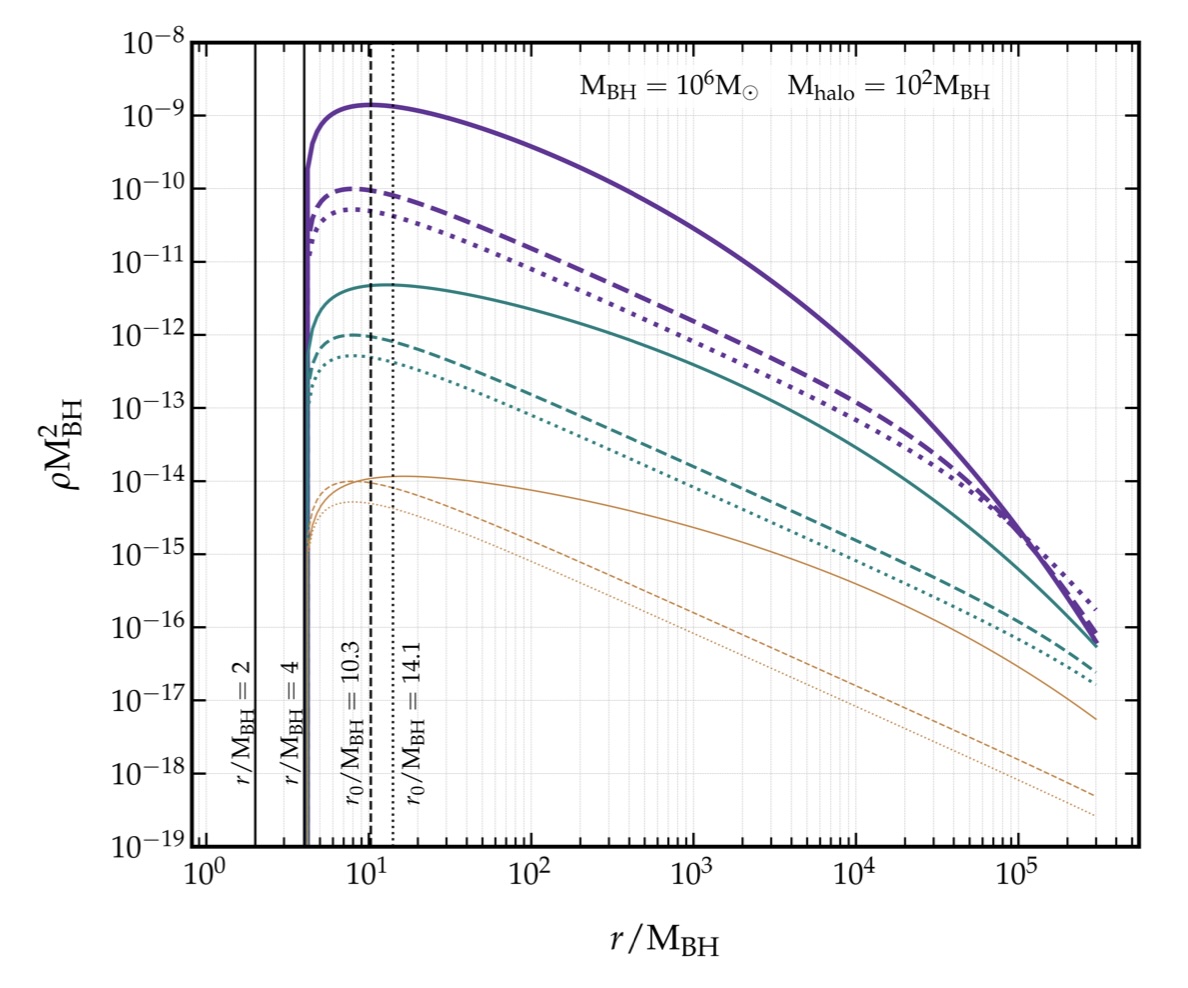
Binary black hole systems do not evolve in isolation. Rather, they can be surrounded by gas, dark matter, and fields that populate our Universe. In my current work, I investigate how astrophysical environments, such as dark matter halos around massive black holes, affect the dynamics, tidal response, and gravitational-wave emission of compact binaries, and how these environmental signatures can be distinguished from vacuum or beyond-GR effects.
Selected Papers
- Orbital evolution of asymmetric binaries within accreting environments A. Radulea, M. E. Rubio, K. Kritos, A. Maselli (2026)
- A multi-parameter expansion for the evolution of asymmetric binaries in astrophysical environments S. Datta, A. Maselli (2025)
- Extreme mass ratio inspirals in dark matter halos: Dynamics and distinguishability of halo models S. Gliorio, E. Berti, A. Maselli, N. Speeney (2025)
- Black holes in galaxies: Environmental impact on gravitational-wave generation and propagation V. Cardoso, K. Destounis, F. Duque, R. P. Macedo, A. Maselli (2021)
Asymmetric Binaries and Fundamental Fields
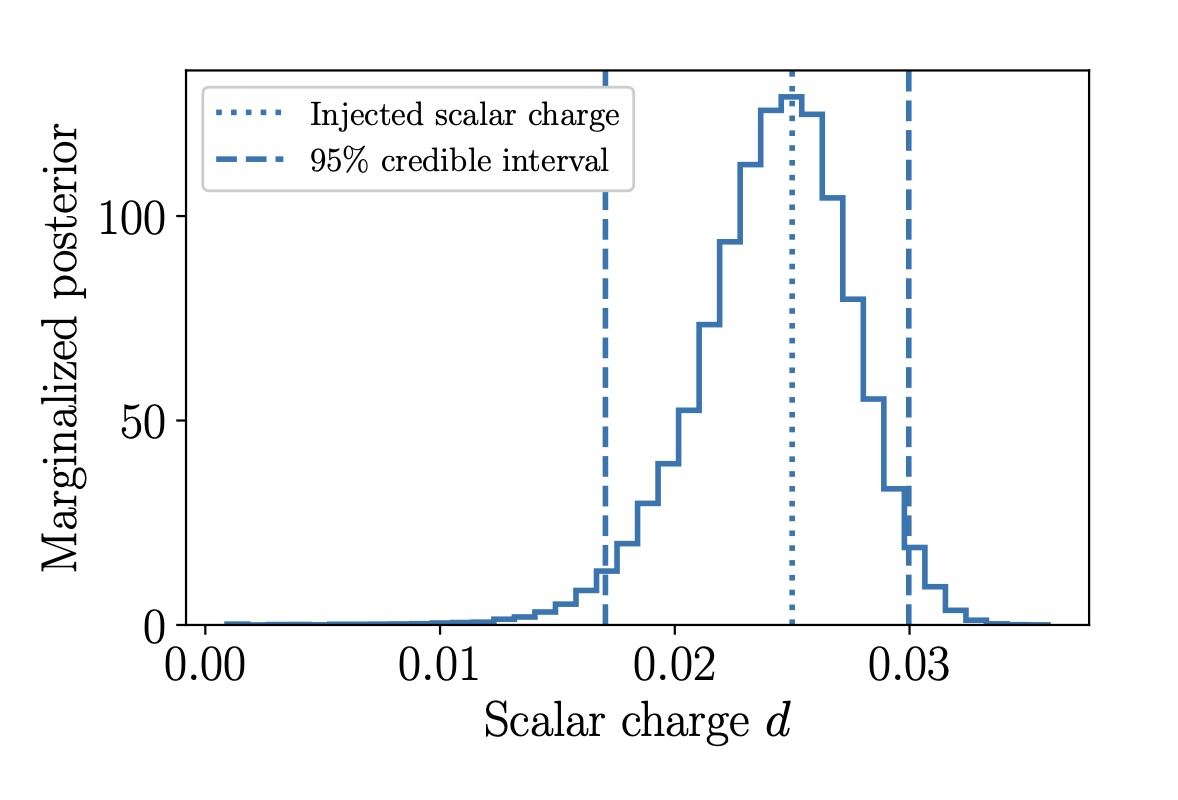
Asymmetric binaries, such as extreme- and intermediate-mass-ratio inspirals (EMRIs and IMRIs) targeted by LISA, provide precision laboratories for testing gravity and searching for new fundamental fields in the Universe. Modelling their dynamics and gravitational-wave emission has been a major focus of my work over the past year. My work develops accurate models of the long-term evolution of EMRIs and IMRIs and assesses the relevance and detectability of deviations from General Relativity with future observations.
Selected Papers
- The significance of first post-adiabatic contributions for scalar charge measurements with intermediate and extreme mass ratio inspirals S. Barsanti, O. Burke, A. Maselli, T. P. Sotiriou, A. Spiers, N. Warburton (2026)
- Adiabatic evolution of asymmetric binaries on generic orbits with new fundamental fields I: characterization of gravitational wave fluxes S. Gliorio, M. Della Rocca, S. Barsanti, L. Gualtieri, A. Maselli, T. P. Sotiriou (2026)
- Detecting fundamental fields with LISA observations of gravitational waves from extreme mass-ratio inspirals A. Maselli, N. Franchini, L. Gualtieri, T. P. Sotiriou, S. Barsanti, P. Pani (2021)
- Probing fundamental physics with extreme mass ratio inspirals: Full Bayesian inference for scalar charge L. Speri et al. (2024)
Black-Hole Spectroscopy and Ringdown
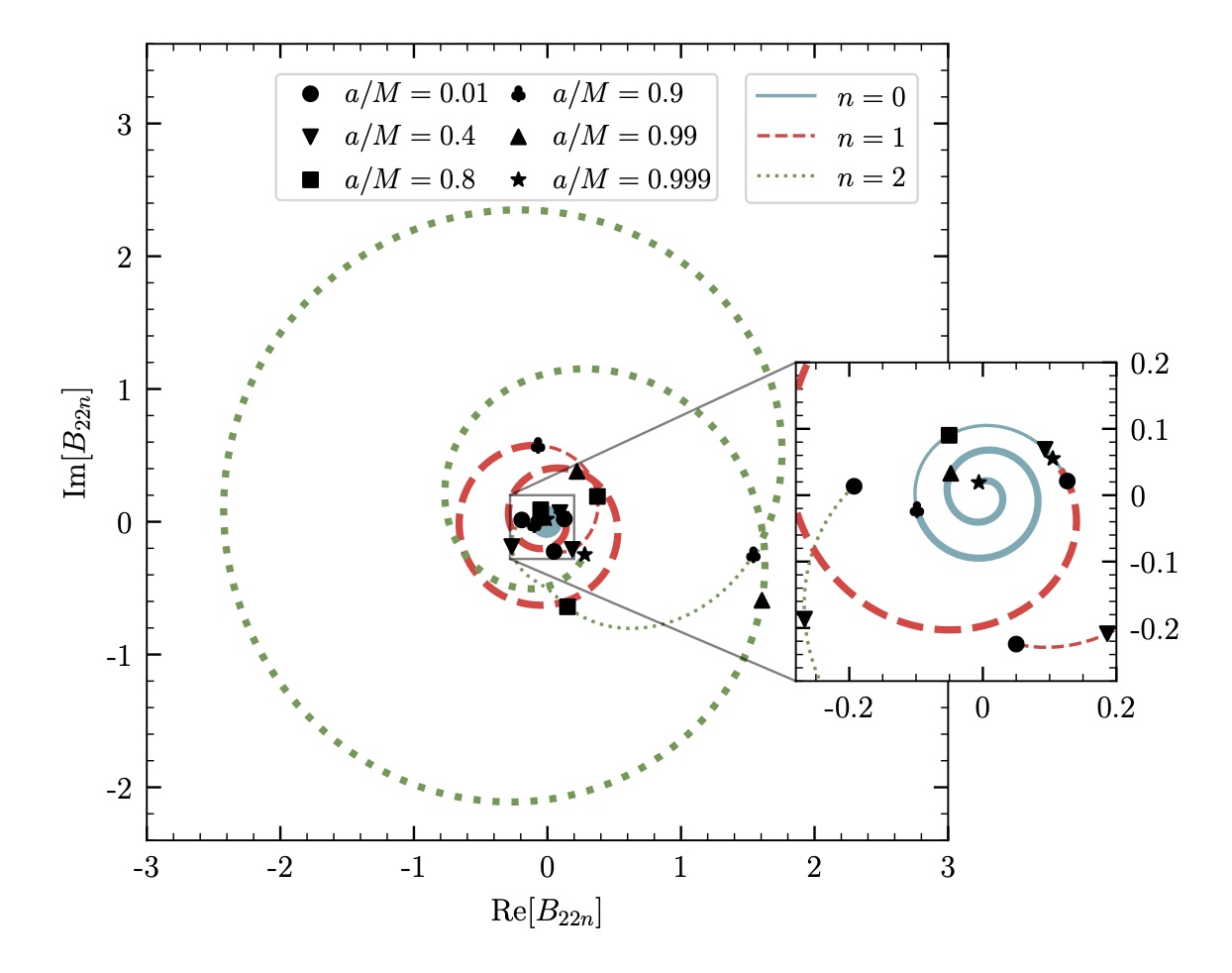
The post-merger ringdown following a binary coalescence carries valuable information about the remnant black hole and its progenitors. The signal's mode amplitudes and oscillation spectrum can be used to infer these properties and probe fundamental physics. I study how ringdown modes are excited and how black-hole spectroscopy can test the Kerr geometry, characterize astrophysical environments, and reveal possible departures from General Relativity.
Selected Papers
- Quasinormal ringing of Kerr black holes. III. Excitation coefficients for equatorial inspirals from the innermost stable circular orbit M. Della Rocca, L. Pezzella, E. Berti, L. Gualtieri, A. Maselli (2025)
- Quasinormal modes of black holes embedded in halos of matter L. Pezzella, K. Destounis, A. Maselli, V. Cardoso (2024)
- Nonlinear quasinormal mode detectability with next-generation gravitational wave detectors S. Yi, A. Kuntz, E. Barausse, E. Berti, M. H. Cheung, K. Kritos, A. Maselli (2024)
- Black hole spectroscopy beyond Kerr: Agnostic and theory-based tests with next-generation interferometers A. Maselli, S. Yi, L. Pierini, V. Vellucci, L. Reali, L. Gualtieri, E. Berti (2023)
Collaborations
I am currently a member of the INFN Specific Initiative TEONGRAV, "Theory of Gravitational Wave Sources", as well as of the following international collaborations developing the science case for future gravitational-wave observatories and advancing strong-gravity research.
-
 LISA The first gravitational space-based gravitational-wave observatory with arm-length of 2.5 million km.
 -
 Einstein Telescope The future European third-generation ground-based gravitational-wave observatory.
 -
 Lunar Gravitational-Wave Antenna A new concept of Lunar gravitational wave observatory targeting signals emitted in the decihertz band.
 -
STRONG STRONG is a Marie Skłodowska-Curie Staff Exchange Action dedicated to investigating gravity in its most extreme regimes, where compact objects, high-energy phenomena, and fundamental fields interact, for which I serve as Principal Investigator.