Tactical and statistical notes on the Green Bay Packers.
Game archive
2026 Season
WEEK 13:25 PM CDT
GB22
—
MIN39
FINALU.S. Bank Stadium
Minneapolis, Minnesota
Stats
Metric
GB
MIN
2026 season
Trend
Efficiency
Offensive EPA/play
-0.175
-0.020
-0.175
Defensive EPA/play allowed
-0.020
-0.175
-0.020
Offensive success rate
38.8%
35.6%
38.8%
Defensive success rate allowed
35.6%
38.8%
35.6%
Passing and rushing
Dropback EPA/play
-0.059
0.075
-0.059
Rush EPA/play
-0.429
-0.054
-0.429
Completion percentage over expected
-9.7 pp
-4.9 pp
-9.7 pp
Pass rate over expected
-1.9 pp
-8.6 pp
-1.9 pp
Explosiveness
Explosive-play rate
13.4%
3.4%
13.4%
Explosive-play rate allowed
3.4%
13.4%
3.4%
Pressure
QB-hit rate allowed
32.6%
16.1%
32.6%
Defensive QB-hit rate
16.1%
32.6%
16.1%
Sack rate allowed
8.7%
10.7%
8.7%
Defensive sack rate
10.7%
8.7%
10.7%
Situational
Third-down efficiency
25.0%
53.3%
25.0%
Red-zone touchdown efficiency
25.0%
100.0%
25.0%
Turnover margin
-1
+1
-1
Penalties / yards
12 / 98
3 / 15
12 / 98
Neutral-situation pace
20.9 sec/play
40.0 sec/play
20.9 sec/play
EPA and success rates use valid run and pass plays; defensive figures are opponent values allowed. Explosive plays are passes gaining at least 20 yards or runs gaining at least 10. QB-hit rates use dropbacks, while sack rates use pass attempts including sacks. Penalties and yards are accepted team penalties and enforcement yardage. Neutral pace is the mean game-clock interval between consecutive offensive snaps in the same drive during quarters 1-3 with the score within eight points.
Flow, score effects, and pivotal shifts will be added after the game.
Offense
Personnel, sequencing, and quarterback play will be assessed after the game.
Defense
Front structure, coverage, and pressure patterns will be assessed after the game.
What Stood Out
Notable performances, unusual trends, and decisive plays will be added after the game.
WEEK 21:00 PM EDT
GB20
—
NYJ17
FINAL/OTMetLife Stadium
East Rutherford, New Jersey
Stats
Metric
GB
NYJ
2026 season
Trend
Efficiency
Offensive EPA/play
-0.222
-0.106
-0.195
Defensive EPA/play allowed
-0.106
-0.222
-0.067
Offensive success rate
32.0%
38.0%
35.9%
Defensive success rate allowed
38.0%
32.0%
36.9%
Passing and rushing
Dropback EPA/play
-0.099
0.086
-0.075
Rush EPA/play
-0.441
-0.439
-0.435
Completion percentage over expected
-13.6 pp
5.9 pp
-11.3 pp
Pass rate over expected
-3.3 pp
4.7 pp
-2.5 pp
Explosiveness
Explosive-play rate
6.0%
4.2%
10.3%
Explosive-play rate allowed
4.2%
6.0%
3.8%
Pressure
QB-hit rate allowed
9.4%
16.7%
23.1%
Defensive QB-hit rate
16.7%
9.4%
16.5%
Sack rate allowed
9.4%
9.1%
9.0%
Defensive sack rate
9.1%
9.4%
9.7%
Situational
Third-down efficiency
11.1%
42.1%
19.0%
Red-zone touchdown efficiency
50.0%
66.7%
37.5%
Turnover margin
-1
+1
-2
Penalties / yards
14 / 133
13 / 156
26 / 231
Neutral-situation pace
41.3 sec/play
31.2 sec/play
32.6 sec/play
EPA and success rates use valid run and pass plays; defensive figures are opponent values allowed. Explosive plays are passes gaining at least 20 yards or runs gaining at least 10. QB-hit rates use dropbacks, while sack rates use pass attempts including sacks. Penalties and yards are accepted team penalties and enforcement yardage. Neutral pace is the mean game-clock interval between consecutive offensive snaps in the same drive during quarters 1-3 with the score within eight points.
It wasn’t pretty. LaFleur’s words right after the game sum up quite well
the Packers’ longest game of the season so far, ending with a thrilling
finish in OT.
The Packers were challenged to provide a fast and strong response after
the collapse against the Vikings, possibly showing that the fourth-quarter
collapse was more of an unexpected event than the team’s usual response
when adversity takes over the script. LaFleur’s team has lost nine times
since 2023 after leading in the fourth quarter, four of those times while
holding a lead of 10+ points.
The Packers’ answer was neither pretty, decisive, nor convincing. In fact,
putting aside for a moment the NFL mantra — which I have never particularly
liked — a win is a win, the game leaves even more question marks about
the rest of the season. In my view, offensive efficiency, O-line consistency,
and team discipline were the areas where the high marks from the opener were
asking for confirmation in this game. Aside, the O-line, I believe the other
two actually went south.
In particular, GB committed 14 penalties for 133 yards, worsening the
performance of the opener in Minnesota. This is an aspect that I find
particularly worrying. Beyond the technical and tactical aspects related to
players and coaching staff, giving away so many yards on penalties seems to
suggest, already this early in the season, a lack of common purpose among the
players and an inability by the coaching staff to instill and maintain
discipline.
Offense
Jordan Love and his unit managed to worsen the offense in almost every statistical
category. The success rate dropped to 32% (from 38%), with the pass rate over
expected twice as low as against the Vikings in Week 1. True, Love connected
for touchdowns with both Watson — who is having the best start to a season
of his career in terms of TD receptions — and MarShawn Lloyd, who scored his
first NFL touchdown, although the latter seemed more like a fortunate outcome
from a broken play. Still, a 55% completion rate and an average of 5.0 yards
per play don’t really catch the eye. Most of all, the Jets defense — or perhaps
the inability of the Packers offense — cut the rate of explosive plays in
half compared with the season opener, taking away one of the ideological
pillars of LaFleur’s offense.
The O-line seems to have done a better job of protecting Love in the pocket. Part of this,
however, was also due to LaFleur adapting his strategy toward a quicker passing game,
significantly relieving the front line of the pressure it faced against Brian Flores’ unit
in Week 1. Along with this adjustment, I think the O-line looked slightly more comfortable,
with the QB-hit rate dropping and Love appearing more secure in the pocket while
progressing through his reads. On a positive note, there was also some improvement in
red-zone efficiency, which has been a red flag for the Packers since the end of last season.
Overall, I thought the passing game showed some improvement, whether because of
the team’s adjustments or the opponent. The rushing game, however, remains a major
problem. The running backs accumulated only 63 yards on 18 carries, averaging 3.5
yards per attempt. The problems extended beyond the O-line: receivers and tight
ends also played their part, missing blocks and assignments.
Defense
The game was largely taken over by both defenses, which kept the score at a
low 7–7 until the end of the third quarter and effectively controlled the game
until the final eight minutes of regulation, when Love led the comeback.
The Packers defense hit the quarterback almost twice as often as the Jets did,
while recording a similar number of sacks — four for the Packers and three for
the Jets. Lukas Van Ness had one of those days, with 10 total tackles, 1.5
sacks, four QB hits and three tackles for loss, making his presence more than
felt by the Jets offense. The Packers were also more effective at the line
of scrimmage, recording nine tackles for loss, compared with six by the Jets.
Looking at these numbers, it seems that the GB
defensive corps had a very productive game at the individual level.
However, team-wise, the balance shifted toward the Jets, with the
Packers allowing their offense to operate at a somewhat higher success rate.
In fact, GB lost more than twice as much expected-point value per play as the
Jets, with an offensive EPA of −0.222 compared with the Jets’ −0.106. On the
other hand, GB did a better job of limiting explosive plays, allowing them on
just 4.2% of plays compared with 6.0% allowed by the Jets.
A mention of (dis)honour goes to Javon Bullard. For a team looking for
discipline, the unsportsmanlike conduct penalty called on third-and-9 in the
first quarter, after successfully defending a pass, was inexcusable.
What Stood Out
The score remained 7–7 until the final three minutes of the third quarter.
It was not a game defined by clear-cut turning points; momentum remained
fairly steady throughout. Still, the special teams unit deserves an honorary
mention. Green Bay allowed only two yards on three returns, consistently
nailing the Jets deep in their own territory at each field change.
A special mention goes to Trey Smack. Not that he did anything special, but
that is probably the point. After years of struggles at the position, the
Packers may have finally found a reliable kicker.
Q41:20
Fourth-down stop
The defense stopped Braelon Allen at midfield on fourth-and-one right
before the end of regulation. A first down there would almost certainly
have put the Jets in position for a game-winning field goal.
WEEK 37:15 PM CDT
GB14
—
ATL35
FINALLambeau Field
Green Bay, Wisconsin
Stats
Metric
GB
ATL
2026 season
Trend
Efficiency
Offensive EPA/play
0.014
0.332
-0.122
Defensive EPA/play allowed
0.332
0.014
0.066
Offensive success rate
39.7%
64.6%
37.2%
Defensive success rate allowed
64.6%
39.7%
46.2%
Passing and rushing
Dropback EPA/play
0.066
0.366
-0.017
Rush EPA/play
-0.301
0.309
-0.410
Completion percentage over expected
-8.5 pp
8.8 pp
-10.1 pp
Pass rate over expected
11.8 pp
-6.6 pp
2.5 pp
Explosiveness
Explosive-play rate
6.3%
12.3%
8.9%
Explosive-play rate allowed
12.3%
6.3%
6.7%
Pressure
QB-hit rate allowed
22.2%
3.8%
22.7%
Defensive QB-hit rate
3.8%
22.2%
13.3%
Sack rate allowed
1.9%
0.0%
6.1%
Defensive sack rate
0.0%
1.9%
7.1%
Situational
Third-down efficiency
40.0%
60.0%
27.8%
Red-zone touchdown efficiency
50.0%
80.0%
41.7%
Turnover margin
0
0
-2
Penalties / yards
6 / 45
6 / 83
32 / 276
Neutral-situation pace
29.5 sec/play
32.7 sec/play
31.7 sec/play
EPA and success rates use valid run and pass plays; defensive figures are opponent values allowed. Explosive plays are passes gaining at least 20 yards or runs gaining at least 10. QB-hit rates use dropbacks, while sack rates use pass attempts including sacks. Penalties and yards are accepted team penalties and enforcement yardage. Neutral pace is the mean game-clock interval between consecutive offensive snaps in the same drive during quarters 1-3 with the score within eight points.
Nobody expected the Packers to suddenly turn into a historically high-scoring offense,
or the O-line to become the Cowboys’ Great Wall.
Yet nobody expected, either, that after five minutes the Falcons would expose everything that has been
wrong with LaFleur’s team — probably since the beginning of his tenure in Green Bay.
The Packers were called upon to build on the win over the Jets, and in particular to show
that the offense — and the O-line especially — was finally on a path toward
greater efficiency and solidity.
By the end of the first quarter, I could already have written the final summary of the game,
regardless of the final score: atrocious O-line, poor decisions by Love, non-existent run game,
poor defense. More shocking, and incredibly frustrating, was a general lack of purpose across
the entire team, almost as if the fate of the squad had somehow already been written.
The Packers were booed by their own fans at Lambeau. It was difficult to imagine anything worse.
Then Tucker Kraft decided to criticize the fans for their lack of support in a postgame interview.
Perhaps someone should explain to Kraft that professional sports entertainment — and,
ultimately, his salary — works as long as fans remain entertained.
Given the effort they make to follow and support the team, they have every right to
criticize his performance.
Offense
When the Packers scored with Watson on the second possession, I thought
LaFleur and the offense had finally managed to install a good game plan.
What followed were 27 unanswered points by the Falcons, stretching into the
fourth quarter, a final offensive EPA of 0.014 — basically zero expected points
added per play — and an offensive success rate below 40%. Notably, a rush EPA
of -0.301, with 17 (17!) yards on 9 (9!) carries, which forced the offense to become
one-dimensional and Love to throw 53 times.
The complete inability of the team to run the ball is a dagger to
LaFleur’s offense, which needs both air and ground threats to move the
ball as vertically as possible with explosive plays (the team had a 6%
explosive-play rate, compared with an average of 8.9% across the season).
Josh Jacobs, the sky knows when/if he will return, would probably not
add much to this picture. And we all know who to blame.
The offensive line was atrocious, both in pass protection and in the run game.
Lack of communication, lack of experience, poor fundamentals, players
not up to the standard. Maybe a linear combination of all of the above.
The QB-hit rate allowed jumped to 22.2%, more than twice the 9.4%
recorded against the Jets the previous week.
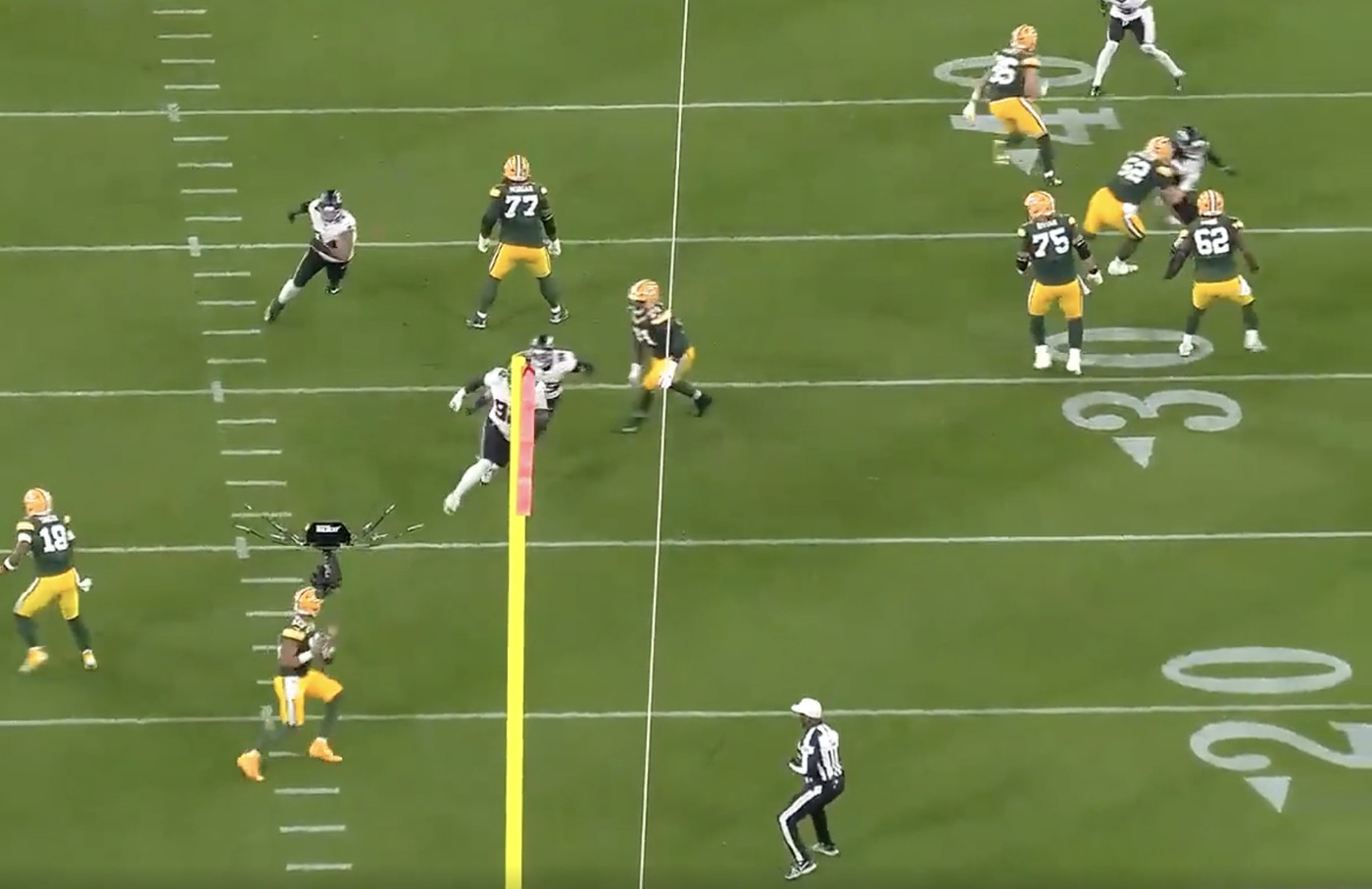
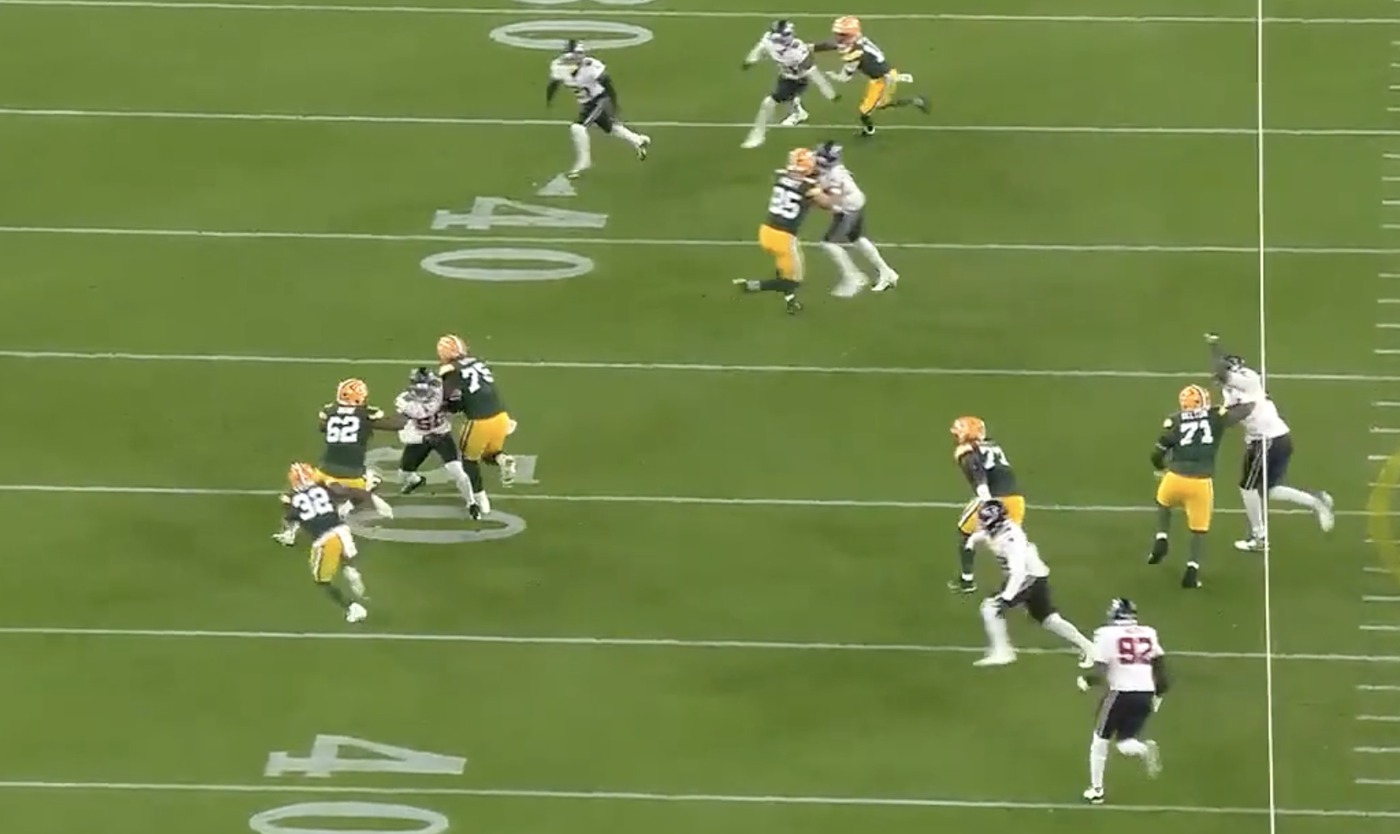
I think some frames from the game speak for themselves about how
this offense operated. The examples I’ll discuss here
all come from the first half, but the underlying problems
remained largely unchanged after halftime
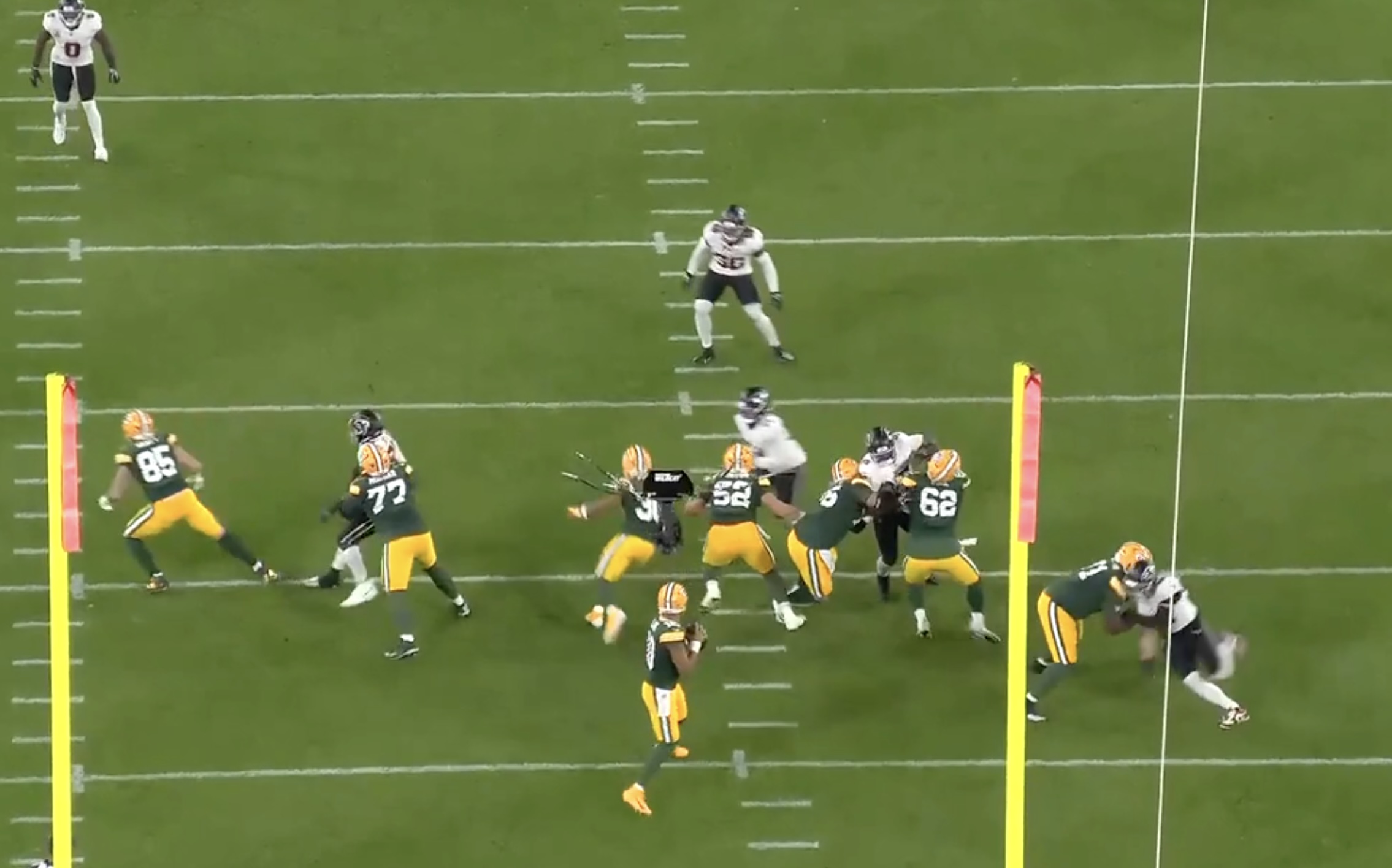
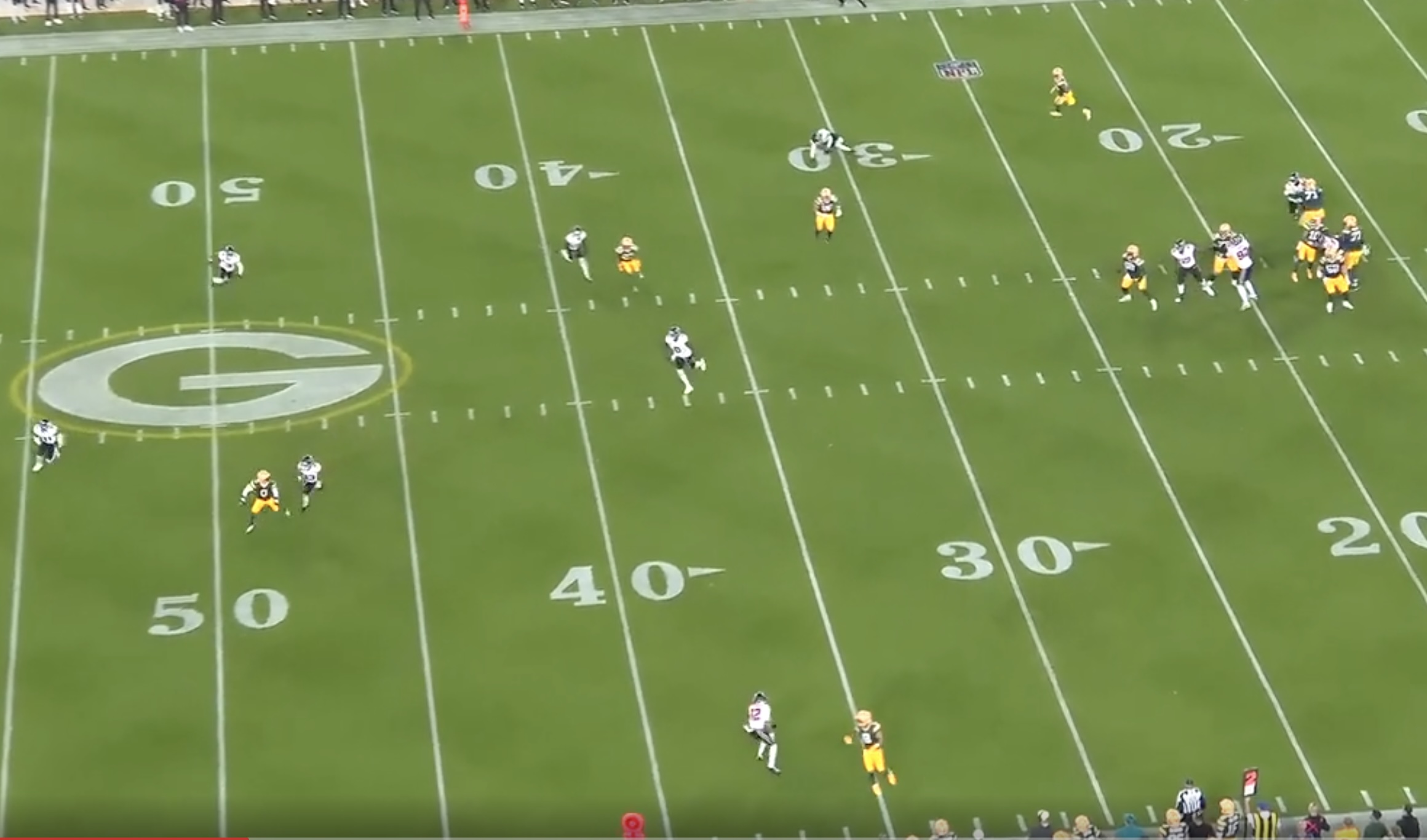
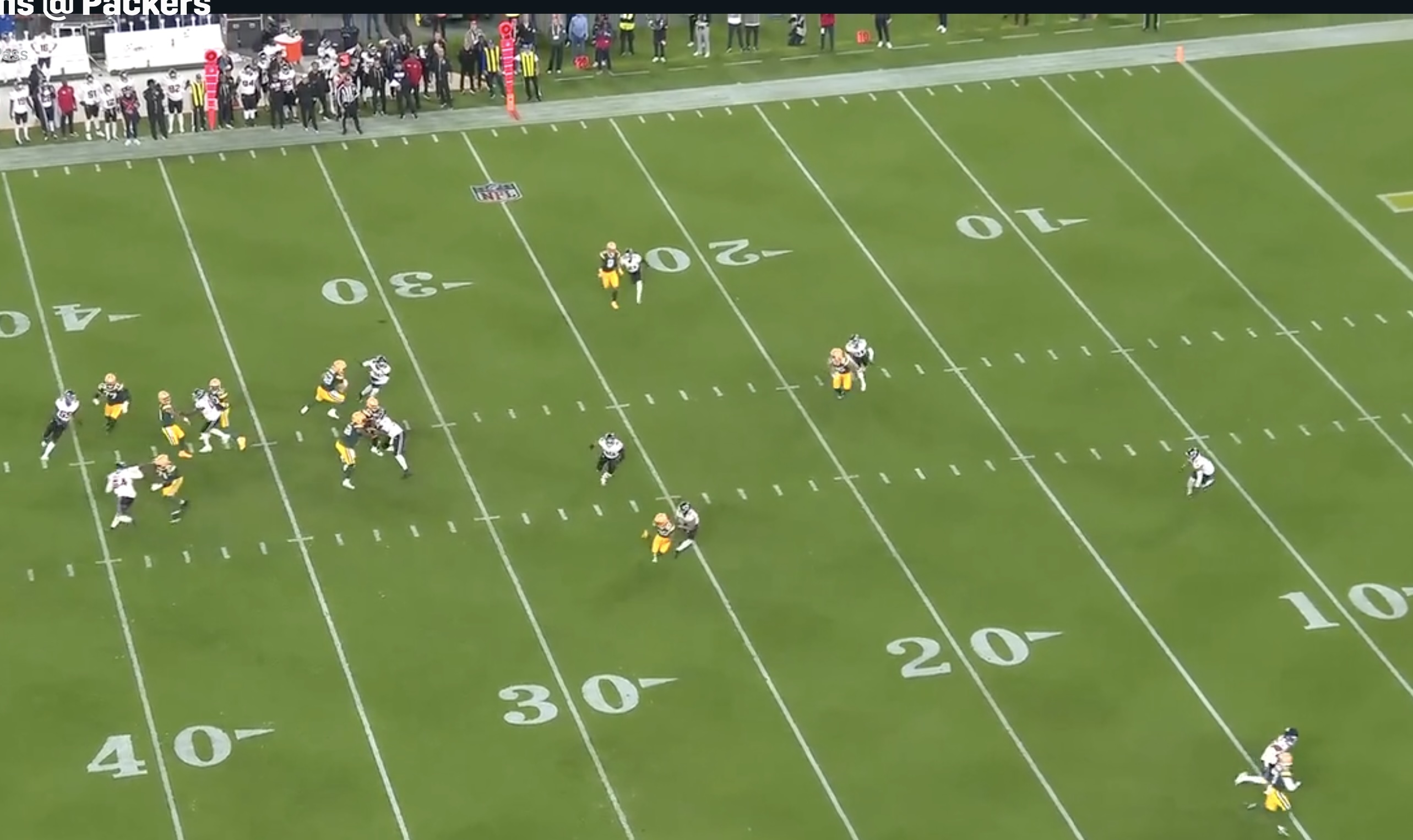
The two figures in the first row below show two screen-pass plays, which
to me highlight the complete disorganization of the blocking.
In the first case, Love passed to Lloyd, who was immediately tackled,
despite having three O-linemen blocking for him against only one Atlanta linebacker.
On the second play, Lloyd is able to gain more yards, but both Packers O-linemen
contribute almost nothing to the play, being immediately overwhelmed by
a single Falcons defender.
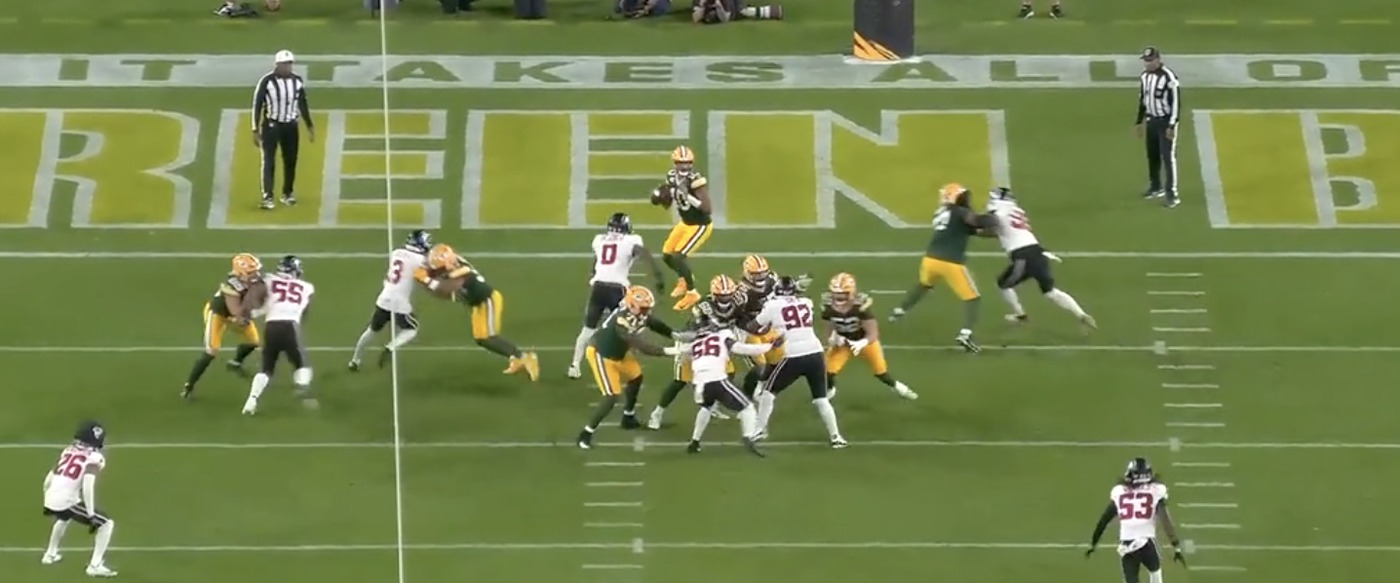
Pictures in the second row show why Love may not survive the 2026 season.
In the first image, Love is able to complete a pass to Kraft out of desperation,
with the three Falcons defenders on the right still able to hit Love at the end
of the play with a dangerous pancake. The second picture is almost inexplicable.
Love has the ball at the Packers’ 12-yard line and is hit by a Falcons linebacker
left completely unblocked to run at full speed toward the QB.
Q1 · 1st & 10 · 1:21Q1 · 1st & 20 · 8:16
Q1 · 3rd & 13 · 0:30Q2 · 3rd & 9 · 9:43
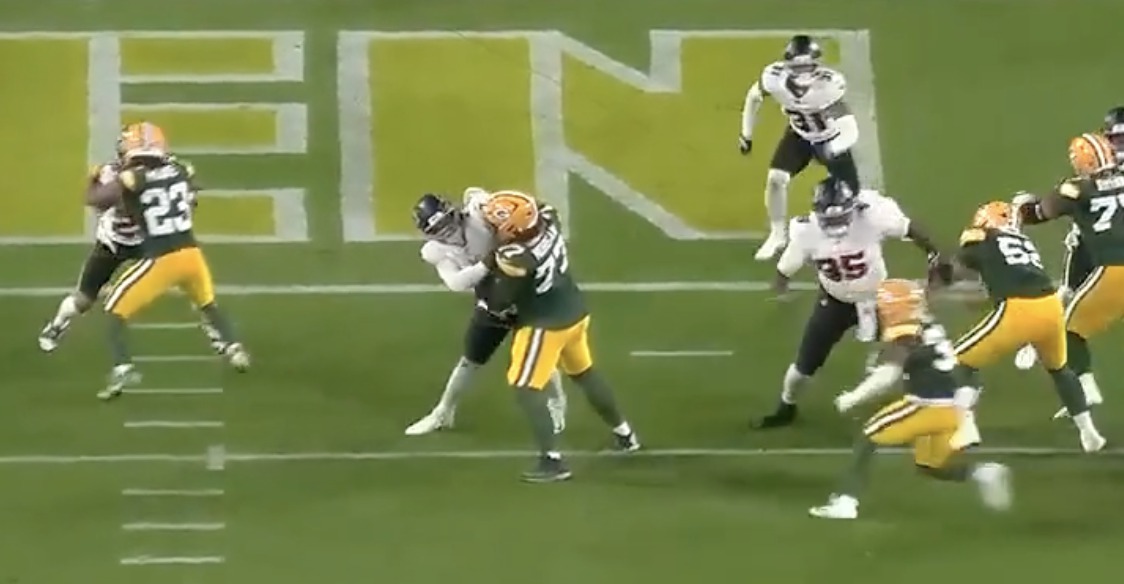
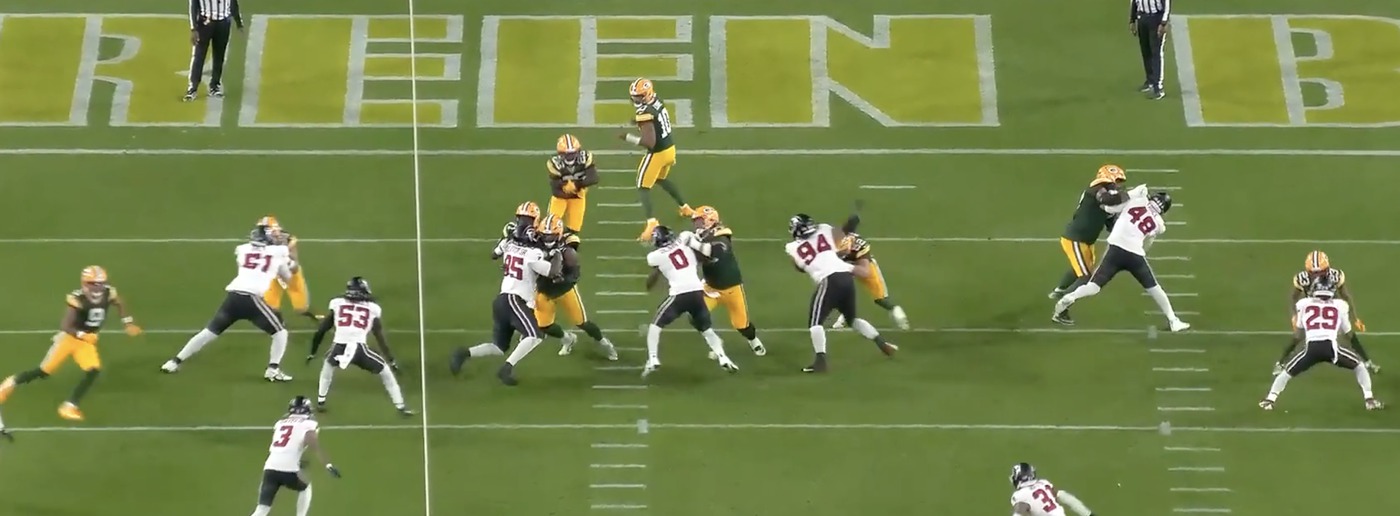
Blocking in the run game clearly did not work either.
Look at the two pictures below. In both cases Lloyd has no space
in the gap to run through, with O-linemen collapsing or leaving
defenders completely free to tackle the runner. In the second picture,
No. 53 of the Falcons is literally in the gap through which Lloyd is supposed
to run…
Q1 · 2nd & 1 · 6:01Q2 · 1st & 11 · 10:33
While almost every sports outlet is probably pointing fingers at the
O-line — rightfully so — in my opinion Love’s performance, and his style of
play more generally, were not convincing either. I want to spend more than a
few words on this, and be honest. I don’t believe Love is a winning type of
QB, if such a breed even exists. To be precise with the terminology, to me
a winning QB is one who gets first downs. Multiple times. Consistently. Moving
the chains and exhausting the opposing defense. Six years into the league,
Love instead keeps favoring hero balls, deep passes into double coverage
and extremely tight windows with a very low probability of completion, rather
than checkdowns and efficient short plays that could move the chains.
Sure, when the pass connects — and often you also need an adjustment by
the receiver and a pinch of luck — the crowd explodes and everything seems
perfect. But in the grand scheme of things, how much does Love’s style actually
help the Packers win?
When LaFleur says at halftime that one of the offense’s problems is its
inability to get into rhythm, well, I believe Love’s style becomes part
of the problem.
The pictures below show, in my opinion, two situations in which
better — or simply different — choices could have led to different
results. On the left, the Packers are facing second-and-13 from their own 20-yard line.
Kraft in the middle and Brooks in the flat are open, but Love decides
to throw a deep ball to Golden in double coverage. The pass falls incomplete,
and the drive ends in a three-and-out on the next play. On the right, it is
second-and-5 in the second quarter. Here the receivers are covered more
effectively by the defense, but Kraft still has inside leverage on his defender.
Instead of attacking the middle of the field, Love again chooses
a 30-plus-yard throw to Golden, who is running a corner route. Once
again, three-and-out.
Q1 · 2nd & 13 · 0:36Q2 · 2nd & 5 · 3:56
According to PerThirtySix,
Love has a CPOE of -10.1 over three weeks
(Completion Percentage Over Expected), with a success rate of 40%.
By comparison, Purdy leads with +6.3 and a 65.2% success rate.
To add a few numbers from the first few weeks, Love has an aDOT
(Average Depth of Target) of 8.97, not too far below Purdy, again, at 10.65.
In summary, it seems to me that Love has a tendency to throw deep, while his
completion percentage and success rate remain low, meaning the QB (and the offense)
are not really able to move the chains.
Along with Love and LaFleur’s vertical offense, I also believe that part of this
problem is overcompensation for the poor pass protection. Love has one of the
lowest times to throw in
the league through Week 3. He seems to try to make the most of the few clean
opportunities he gets in the pocket to compensate for those in which he has to
scramble for his life.
Defense
The interception 30 seconds into the game, and the three-and-out on the very
next possession, seemed to set the stage for a shutdown performance by the Packers defense.
Things went really south instead, with Gannon’s group run over — literally — by
the Falcons.
The epitome of the defensive performance is probably in two numbers:
41 carries for a total of 242 yards on the ground by Atlanta, with the majority
(194) coming from Bijan Robinson.
Atlanta’s offense was successful on 64.6% of its plays, with a very positive 0.332
expected points added per action. The Falcons basically succeeded on two out of three
plays, regardless of whether they attacked on the ground or through the air.
Combined with zero sacks (9.1% defensive sack rate against the Jets) and a 3.8% QB-hit rate
(16.7% against the Jets) by the Packers, we can fairly say that Atlanta’s O-line
controlled the line of scrimmage in both phases, either protecting Penix
or opening lanes for their running backs.
What Stood Out
Q13:06
Roughing the passer
I get it, a penalty in the first quarter cannot define a game. Yet, when
Brenton Cox roughed the passer, erasing a third-down stop by the
defense, I felt something in the overall momentum of the game had just changed.
Not to mention, on the very next play Bijan Robinson rushed for more than 50 yards
into Green Bay territory, setting the stage for Atlanta’s touchdown.
Q310:01
Another 4th-and-1 stop
I understand there was no other option. And it was also important to send a message,
showing that the team was fully committed to getting back into the game. Still, failing
to convert a fourth-and-1, 12 yards from the Falcons’ goal line, probably put a
dagger through the Packers’ comeback hopes.
WEEK 41:00 PM EDT
GB17
—
TB14
FINALRaymond James Stadium
Tampa, Florida
Stats
Metric
GB
TB
2026 season
Trend
Efficiency
Offensive EPA/play
0.018
-0.038
-0.091
Defensive EPA/play allowed
-0.038
0.018
0.041
Offensive success rate
46.2%
44.3%
39.2%
Defensive success rate allowed
44.3%
46.2%
45.7%
Passing and rushing
Dropback EPA/play
0.230
-0.078
0.028
Rush EPA/play
-0.271
0.065
-0.366
Completion percentage over expected
5.3 pp
1.2 pp
-7.0 pp
Pass rate over expected
1.0 pp
-6.4 pp
2.2 pp
Explosiveness
Explosive-play rate
5.8%
6.6%
8.2%
Explosive-play rate allowed
6.6%
5.8%
6.6%
Pressure
QB-hit rate allowed
6.7%
19.4%
19.8%
Defensive QB-hit rate
19.4%
6.7%
14.9%
Sack rate allowed
0.0%
10.0%
4.9%
Defensive sack rate
10.0%
0.0%
7.8%
Situational
Third-down efficiency
20.0%
41.7%
26.1%
Red-zone touchdown efficiency
66.7%
100.0%
46.7%
Turnover margin
0
0
-2
Penalties / yards
10 / 68
4 / 17
42 / 344
Neutral-situation pace
34.6 sec/play
30.3 sec/play
32.7 sec/play
EPA and success rates use valid run and pass plays; defensive figures are opponent values allowed. Explosive plays are passes gaining at least 20 yards or runs gaining at least 10. QB-hit rates use dropbacks, while sack rates use pass attempts including sacks. Penalties and yards are accepted team penalties and enforcement yardage. Neutral pace is the mean game-clock interval between consecutive offensive snaps in the same drive during quarters 1-3 with the score within eight points.
I am not sure what I was expecting from this game.
Considering my overall concerns about the team and LaFleur’s
management, a complete collapse by the Packers against a 0-3
team missing its starting QB was not an event with zero
probability. For sure, I would have expected a spark of
pride, something to prove that the players want to fight for
every inch of the field while wearing the Green and Gold.
Instead, the Battle of the Bays turned into a battle in
the mud. One of those victories (please don’t tell me a
win is a win) that are indicative of how bad the team
is (at least at the moment). A thrilling 17-14 victory,
with an absolutely boring second half in which the two teams
scored a combined 14 points, and undrafted rookie Jalon Daniels,
replacing an injured Baker Mayfield, scored his first NFL touchdown
(and threw two picks).
All of this after Brian Gutekunst went into emergency mode
during the week, signing four veteran O-linemen and reversing
his preseason optimism. Many (including LaFleur) would say
that there were some positive signs compared with the Falcons
game. I don’t want to play the role of the “always negative critic”,
but questions about whether these positives are random occurrences
or the seeds of a structured improvement remain very much open.
With the Bears up next, I guess we’re going to see
what kind of mettle this team is made of.
Offense
Let’s start with the good things, then. The new additions,
Travis Glover and Laken Tomlinson, took their places
at right and left guard, respectively. Out of necessity
(Aaron Banks and Jacob Monk are injured) or by choice, the
changes seemed effective, with the O-line performing
well, at least in pass protection. The QB-hit rate allowed
dropped to a season low of 6.7%, with Love taking no sacks.
The offensive success rate also improved considerably,
reaching 46.2%, the highest so far in 2026, along with
a very positive 0.230 dropback EPA/play (0.066 against
the Falcons).
That said, the Bucs didn’t enter Week 4 with
an elite defensive front, having one of the lowest pressure
rates in the league.
And in fact, highlighting how dysfunctional the Packers offense remains
despite the O-line’s progress, offensive EPA/play stagnated at an almost
irrelevant 0.018 (0.014 in Week 3).
The running game remains the weak point of LaFleur’s offense.
The Packers clearly tried to be more balanced,
attacking on the ground more often than in the previous game
(pass rate over expected dropped to 1.0 pp from
11.8 pp in Week 3). Rush EPA/play
remained consistently negative: the team rushed for 86 yards in total
on 25 carries, almost half of Tampa Bay’s total, averaging a very modest
3.5 yards per rush.
The Packers rank last in the league in yards before contact per RB rush, with
an average of 0.5 yards across the first four weeks. This suggests that
the O-line is not really creating running lanes for the
running backs, leaving Lloyd, Johnson and Brooks to generate
additional yardage after contact.
With 6.6 yards per pass, an explosive-play rate remaining flat
at around 6%, and a very low 20% third-down conversion rate,
the offense seemed capable of moving the chains, but only up
to a certain point. Green Bay reached the Buccaneers’
red zone just three times, scoring two touchdowns. Tucker Kraft
scored his first TD of the season, hopefully shaking off the
last rust from his previous injury.
Defense
With the offense struggling to generate enough momentum to win the game,
the defense had to step up to keep the Buccaneers — again with a rookie QB —
in check. Gannon’s group showed it was up to the task from the very beginning.
On the very first series, Edgerrin Cooper, later carted off with a
season-ending injury, sacked Daniels on third down. On Tampa Bay’s next
possession, Ewan Williams intercepted a pass intended for Egbuka on first down.
The defense maintained that intensity throughout the game,
proving to be effective in stopping Tampa’s attack during all quarters,
and holding the opponents to −0.038 EPA/play and a 44.3% offensive success rate.
The defense won the sack battle 3-0, also making its presence felt
by hitting QB Jalon Daniels on 20% of his dropbacks.
Gannon went heavy on the blitz against the Bucs, sending extra rushers on
47.22% of defensive snaps, well above the NFL average.
The strategy paid off, especially on the final series of the game,
with three blitzes on four downs helping Green Bay secure the win.
What Stood Out
The Packers continue their steady path of inflicting as much
damage on themselves as possible, committing 10 penalties for
a total of 68 yards. The team currently holds the dubious
distinction of being the most undisciplined
in the league in terms of penalty yards (344), and ranks
second in the total number of penalties committed (42).
Q38:54
Another man down
Edgerrin Cooper was all over the field during the game,
recording 9 tackles, 1 sack and 1 interception returned for
18 yards. Then he went down with a non-contact injury, which
turned out to be a season-ending Achilles tear. A tremendous loss
for the Packers’ best linebacker so far this season, and a leader
of the defense.
Q41:47
Ewan Williams wreaks havoc
Jonathan Gannon decided to seal the game by sending
Ewan Williams on a blitz mission during the final series.
Williams recorded his first NFL sack on Tampa Bay’s
second down, then forced Jalon Daniels into an incomplete
pass on fourth-and-11, securing the win for the Packers.
WEEK 512:00 PM CDT
GB31
—
CHI7
FINALLambeau Field
Green Bay, Wisconsin
Stats
Metric
GB
CHI
2026 season
Trend
Efficiency
Offensive EPA/play
0.259
-0.340
-0.021
Defensive EPA/play allowed
-0.340
0.259
-0.039
Offensive success rate
46.6%
38.2%
40.7%
Defensive success rate allowed
38.2%
46.6%
44.1%
Passing and rushing
Dropback EPA/play
0.492
-0.477
0.111
Rush EPA/play
-0.077
-0.037
-0.292
Completion percentage over expected
16.2 pp
-7.8 pp
-3.1 pp
Pass rate over expected
5.9 pp
2.0 pp
2.9 pp
Explosiveness
Explosive-play rate
13.8%
7.4%
9.3%
Explosive-play rate allowed
7.4%
13.8%
6.8%
Pressure
QB-hit rate allowed
14.3%
19.1%
18.8%
Defensive QB-hit rate
19.1%
14.3%
16.0%
Sack rate allowed
5.9%
9.1%
5.1%
Defensive sack rate
9.1%
5.9%
8.1%
Situational
Third-down efficiency
33.3%
28.6%
27.6%
Red-zone touchdown efficiency
66.7%
50.0%
50.0%
Turnover margin
+5
-5
+3
Penalties / yards
4 / 25
3 / 20
46 / 369
Neutral-situation pace
34.6 sec/play
23.1 sec/play
33.1 sec/play
EPA and success rates use valid run and pass plays; defensive figures are opponent values allowed. Explosive plays are passes gaining at least 20 yards or runs gaining at least 10. QB-hit rates use dropbacks, while sack rates use pass attempts including sacks. Penalties and yards are accepted team penalties and enforcement yardage. Neutral pace is the mean game-clock interval between consecutive offensive snaps in the same drive during quarters 1-3 with the score within eight points.
I hate the Bears. Since the first time I started following the Packers. One of my fondest
football memories is Aaron Rodgers beating the Bears on one leg, after coming back from injury in
the second half of the 2018 regular-season game.
So this may be the only game in which “a win is a win”, clean or dirty.
That said, the Packers entered Week 5 as heavy underdogs, facing their greatest
rivals
in football after four weeks of criticism, still in search of an identity.
Possibly a defining game, even at this early stage of the season.
The Bears played without their franchise quarterback. Still, I think it is
fair to say that the game went far beyond expectations for the Packers,
who dominated Chicago in every phase of the game. A punch in the face, to quote
Ben Johnson (I could be more explicit if I really wanted to cite him and
lose any sense of etiquette). The Packers scored 31 points, which could have been at least 38
if Trey Smack had done his job when it mattered. And overall, a general sense of domination,
with LaFleur (I liked him a lot today, including his poise during the
postgame handshake) almost seeming intent on ridiculing the opposing defense.
Beyond the excitement, some questions, especially concerning the run
game and the offense’s ability to score in the red zone,
remain open. For the time being, the Packers can prepare with less
pressure and more confidence for the Monday night showdown against the Cowboys.
Offense
If LaFleur could describe one of his offensive dreams, I am pretty sure it
would resemble the performance against the Bears. Love threw for 367 yards,
completing 80% of his passes for 2 TDs and his highest passer rating of
the season. Two more touchdowns by MarShawn Lloyd brought the total to 31
points, which could have been 38 if Smack had done his kicking job.
More than the points, you could feel throughout the game the Packers’
ability (and willingness) to do whatever they wanted against the Bears’ defense.
Watson and Golden both recorded over 100 receiving yards, with
their longest receptions going for 53 and 50 yards, respectively.
Just to give an example of how aggressive LaFleur and Love were — probably
sensing the weaknesses in the Bears’ secondary — the first TD pass
to Christian Watson was a 42-yard bomb on first-and-10 from Chicago’s
42-yard line. The second score was even more impressive. The drive
consisted of just of four plays: a 31-yard pass to Watson, a run
for a loss, an incompletion, a 43-yard touchdown nullified by a penalty,
and finally a 53-yard touchdown pass to Watson.
The Packers recorded an offensive EPA/play of 0.259, their highest this season,
with a massive Completion Percentage Over Expected of +16.2 percentage
points and an explosive-play rate of 13.8%, well above the league median
through five weeks.
As I said, the Bears’ secondary did everything possible to help LaFleur
play his explosive game. But credit also goes to the offensive line,
which has shown progress in pass protection, making Love more comfortable
with his preferred deep-passing style.
If I have to find something to criticize about the offensive performance,
I’d point to two aspects. First, considering how dominant the offense was
on the field, I believe we wasted opportunities to score even more,
with four punts (and two missed field goals).
Second, the running game. Yes, Lloyd scored his first NFL
touchdown, and then added a second. But 70 total rushing yards on 26 carries
is still poor for a team that wants to compete for a postseason spot.
Rush EPA/play remains close to zero, but still negative, and a pass rate
over expected of almost six percentage points signals an offense that
remains largely one-dimensional.
Defense
Four sacks, eight tackles for loss, ten QB hits, three interceptions and two
recovered fumbles. There is little to add except that the Packers’ defense
had a heck of a day, holding the Bears to just seven points, all scored
in the second quarter. Green Bay recorded a defensive EPA/play allowed of
−0.340, by far its lowest value this season, compared with a season average
of −0.034, highlighting its complete control over the Bears’ offense.
Two things stand out above all. First, Gannon continues to demonstrate his
ability to generate pressure on the QB, with a QB-hit rate above 19% for
the second week in a row, even without his star pass rusher Parsons and
the recently injured Edgerrin Cooper.
Second, the Packers’ defense is elite at generating turnovers,
especially when it comes to intercepting the opposing quarterback,
leading
the league in interceptions.
What Stood Out
Only four penalties for 25 yards. A season low for the Packers,
addressing one of the team’s most critical issues so far.
The numbers are particularly significant considering how emotionally
charged the game was, given the rivalry and the crisis Green Bay
had been facing leading up to kickoff.
On the negative side, a big step backward for Trey Smack, who made only
one of three field-goal attempts and missed an extra point. While
wind was clearly a factor — Santos also missed a field goal for the Bears —
the early part of the season has not been exceptional for Smack,
who is 7-for-10 on field goals and 9-for-11 on extra points.
Q313:22
Love goes deep again to the end zone
I was almost shocked when Love went deep again to Watson to score,
right after a 43-yard TD had been erased by an offensive pass interference
penalty. The play really symbolises the attitude with which Green Bay’s
offense entered the game and challenged Johnson’s defense, as well as
his arrogance toward the Packers and their rivalry.
WEEK 67:20 PM CDT
GB23
—
DAL13
FINALLambeau Field
Green Bay, Wisconsin
Stats
Metric
GB
DAL
2026 season
Trend
Efficiency
Offensive EPA/play
0.034
-0.133
-0.010
Defensive EPA/play allowed
-0.133
0.034
-0.056
Offensive success rate
38.2%
42.3%
40.2%
Defensive success rate allowed
42.3%
38.2%
43.8%
Passing and rushing
Dropback EPA/play
0.138
-0.163
0.116
Rush EPA/play
-0.157
-0.070
-0.265
Completion percentage over expected
-5.8 pp
-3.1 pp
-3.6 pp
Pass rate over expected
4.9 pp
5.1 pp
3.3 pp
Explosiveness
Explosive-play rate
8.8%
1.4%
9.2%
Explosive-play rate allowed
1.4%
8.8%
5.8%
Pressure
QB-hit rate allowed
18.2%
12.3%
18.7%
Defensive QB-hit rate
12.3%
18.2%
15.1%
Sack rate allowed
6.8%
1.8%
5.4%
Defensive sack rate
1.8%
6.8%
6.6%
Situational
Third-down efficiency
61.1%
38.5%
35.5%
Red-zone touchdown efficiency
50.0%
50.0%
50.0%
Turnover margin
+1
-1
+4
Penalties / yards
11 / 96
11 / 108
57 / 465
Neutral-situation pace
32.6 sec/play
33.3 sec/play
33.0 sec/play
EPA and success rates use valid run and pass plays; defensive figures are opponent values allowed. Explosive plays are passes gaining at least 20 yards or runs gaining at least 10. QB-hit rates use dropbacks, while sack rates use pass attempts including sacks. Penalties and yards are accepted team penalties and enforcement yardage. Neutral pace is the mean game-clock interval between consecutive offensive snaps in the same drive during quarters 1-3 with the score within eight points.
The Packers winning the Divisional Round against the Cowboys
on January 15, 2017, with an incredible throw and catch by Rodgers and Cook.
The thrilling victory in Dallas during Week 5 of 2017,
with a 12-yard touchdown pass to Davante Adams and only 11 seconds remaining.
These stay two of my fondest Packers memories from my ten years
of following the team. The games against the Cowboys remain part of a strong rivalry
between two NFC teams that face each other at least once every three years.
The Sunday Night game was not the most spectacular among their recent meetings
in terms of scoring. The Packers defense won the game, with Gannon’s group holding
Dallas to just 7 points until the final minute, intercepting Dak Prescott
twice.
The Packers offense came with its usual highs and lows.
The receiving corps, led by Watson and Golden, continues to look elite in the
league — despite three costly drops. The running game, however,
remains the real Achilles’ heel of LaFleur’s offense. Hopefully, Josh Jacobs
coming off the Commissioner’s Exempt List may spark new life into an offense
that, for the moment, looks one-dimensional.
Green Bay is now 4-2 after a rough start to the season and many doubts about
the team’s stability. I believe the Packers are still searching for a real identity,
which will soon be tested against tough opponents over the next four weeks (Lions,
Panthers, Patriots and Vikings).
Offense
I am not sure how to interpret the Packers’ offensive performance. Love
closes the first quarter with a touchdown on the opening possession, followed
by an interception on the second. A field goal and another touchdown
close out the first half. LaFleur’s offense doesn’t punt for the first
time until one minute into the third quarter. Then, plenty of inconsistency,
with only six additional points, all coming from Smack’s field goals.
Offensive EPA/play remains close to the season average at 0.034, with the
second-lowest offensive success rate of the season.
I don’t think Love played particularly well. He completed 56% of his
passes, ranking now third from the bottom in completion percentage among QBs
who have played six games. Completion Percentage Over Expected
against the Cowboys also turned negative at -5.8 percentage points,
after two positive weeks.
On one hand, drops by receivers certainly don’t help: the
Packers rank second
behind the Titans in this unfortunate category, with a 9% drop rate.
Golden dropped a costly pass just one play before catching the
touchdown at the end of the second quarter. On the other hand,
Love also ranks sixth
in percentage of bad throws, which could be partially explained by the
offensive line’s performance. The unit has actually improved in pass
protection over the last two games (following the new additions), although
Love was still sacked three times against the Cowboys.
Love also scored a TD from the 1-yard line. And that was about it for the run
game which, I don’t know how many times we can say this, is basically
non-existent. A rush EPA/play of -0.157, 57 yards in total on 26 carries,
with the longest run coming from Love himself for 13 yards. I don’t think these
numbers even deserve a comment.
I can only hope that Josh Jacobs can help reinvigorate the running game.
Because the current running back corps doesn’t seem up to the task, despite
some recent excitement
which, to me, comes from completely naive analyses.
The 8:17-minute drive in the second quarter, which ended with a field goal
by Smack, summarises the problem, I believe.
The Packers rank ninth in the league with 21 red-zone trips (inside the opponent’s 20),
but 24th in the percentage of trips that ended with a TD, and 31st (second from the bottom) in the percentage of trips
ending with either a TD or a field goal.
We don’t know how to finish drives.
Defense
Let me say it again. Gannon and his unit won the game, there is no doubt about it.
It’s not only that the Cowboys’ offense was almost shut down until garbage time,
but rather the general sense of dominance throughout all four quarters.
The Packers defense was ferocious at every point of contact, holding Dallas
to a defensive EPA of -0.133. I think at times it was “too ferocious”.
Two taunting penalties at this level are inexcusable, and this is something
that could cost the Packers dearly when games become win-or-go-home affairs.
I think the secondary played particularly well. High marks for the
safeties Bullard and Williams, and the cornerbacks Nixon and Cisse,
who combined for 24 tackles.
Among the key plays of the game were interceptions by Williams, who continues
to establish himself as an elite player in the league, and 2025 rookie Cisse,
who is emerging as a leading cornerback for the Packers. A potential third
interception by Carrington Valentine was wiped out by a roughing-the-passer
penalty on Lukas Van Ness at 7:43 in the fourth quarter.
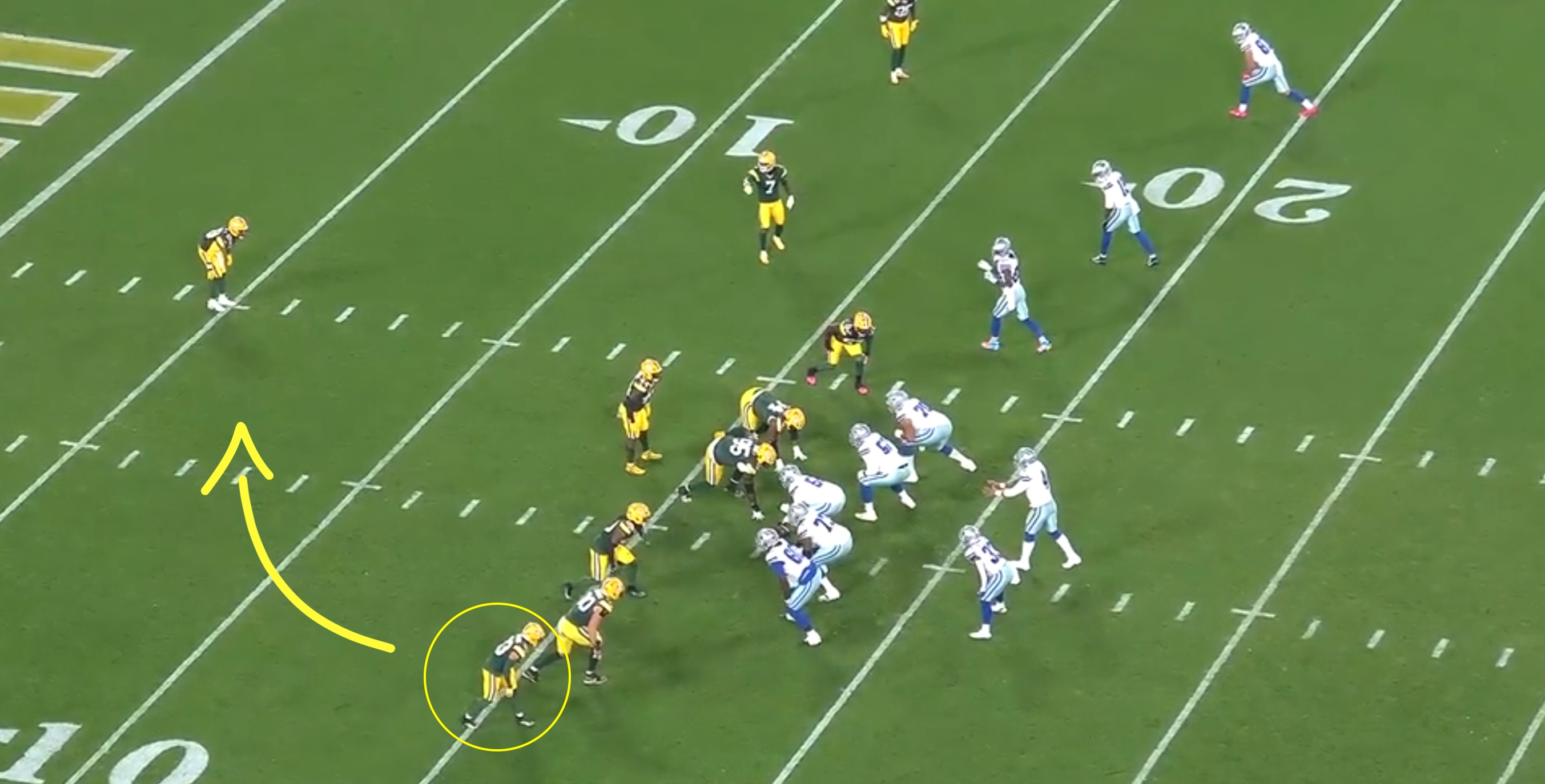
The first interception by the Packers was a thing of beauty, both for the scheme
orchestrated by Gannon and Williams’ execution. The two pictures below
show the play. Prescott was about to throw, still shaken by a heavy hit from
Zaire Franklin, who had blitzed him on the previous play. Williams lined up at
the line of scrimmage, almost as if ready to blitz Prescott again. As soon as the
center snapped the ball, he dropped back toward the middle of the field,
catching Prescott by surprise. The intended throw to Lamb on the right
ended up in the arms of the Packers safety.
I think Williams’ interception was a game changer, coming so early in
the game and killing Dallas’ momentum as they tried to answer the Packers’
opening score.
Q2 · 3rd & 8 · 14:23Q2 · 3rd & 8 · 14:23
The second pick, by Cisse with two minutes remaining in the second quarter,
put a dagger into Dallas, giving Jordan Love the opportunity to score
and send the Packers into halftime with a 17-0 lead.
I also want to give credit to Javon Bullard, whom I have been somewhat critical
of in previous weeks for his excessive passion, which has cost the team
precious yards. His defensive play at the beginning of the fourth quarter,
breaking up a Prescott pass on fourth-and-2, set the final tone for the game,
showing the Cowboys that there was no room for high-risk gambles.
If there is something to criticize, it is the defense’s inability to
consistently pressure the quarterback with its defensive line.
Only one sack, by Van Ness, and the second-lowest QB-hit rate of the season.
Help from Micah Parsons coming off the injury list is much needed at this point.
What Stood Out
Two things worth mentioning. First, 3/3 on field-goal attempts and 2/2 on
extra points for Trey Smack, who finally went perfect for an entire game.
Gold for LaFleur’s special teams unit.
On the negative side, 11 penalties for 96 yards marked the team’s highest total
since Week 2, which now leads the league with 465 penalty yards in total.
While things are improving on other fronts, penalties remain a huge problem
for the Packers. I blame the coaching staff for the team’s lack of discipline.
A winning team cannot sustain this level of self-inflicted punishment —
especially with such narrow margins on offense, and even more so when
games become decisive for the season.
Q214:23
Williams intercepts Prescott
It’s the third time I’ve mentioned this play. But I think Williams’
interception set the tone for the defense throughout the game and broke
Dallas’ early momentum.
WEEK 74:25 PM EDT
GB17
—
DET20
FINALFord Field
Detroit, Michigan
Stats
Metric
GB
DET
2026 season
Trend
Efficiency
Offensive EPA/play
0.037
-0.063
-0.003
Defensive EPA/play allowed
-0.063
0.037
-0.057
Offensive success rate
33.8%
52.3%
39.2%
Defensive success rate allowed
52.3%
33.8%
45.0%
Passing and rushing
Dropback EPA/play
0.151
0.279
0.121
Rush EPA/play
-0.238
-0.415
-0.261
Completion percentage over expected
-0.5 pp
-1.0 pp
-3.1 pp
Pass rate over expected
5.1 pp
-7.2 pp
3.6 pp
Explosiveness
Explosive-play rate
10.8%
10.8%
9.5%
Explosive-play rate allowed
10.8%
10.8%
6.5%
Pressure
QB-hit rate allowed
13.0%
3.0%
17.8%
Defensive QB-hit rate
3.0%
13.0%
13.7%
Sack rate allowed
2.2%
3.0%
4.9%
Defensive sack rate
3.0%
2.2%
6.1%
Situational
Third-down efficiency
33.3%
50.0%
35.2%
Red-zone touchdown efficiency
25.0%
40.0%
46.2%
Turnover margin
+1
-1
+5
Penalties / yards
8 / 81
5 / 50
65 / 546
Neutral-situation pace
29.7 sec/play
30.0 sec/play
32.3 sec/play
EPA and success rates use valid run and pass plays; defensive figures are opponent values allowed. Explosive plays are passes gaining at least 20 yards or runs gaining at least 10. QB-hit rates use dropbacks, while sack rates use pass attempts including sacks. Penalties and yards are accepted team penalties and enforcement yardage. Neutral pace is the mean game-clock interval between consecutive offensive snaps in the same drive during quarters 1-3 with the score within eight points.